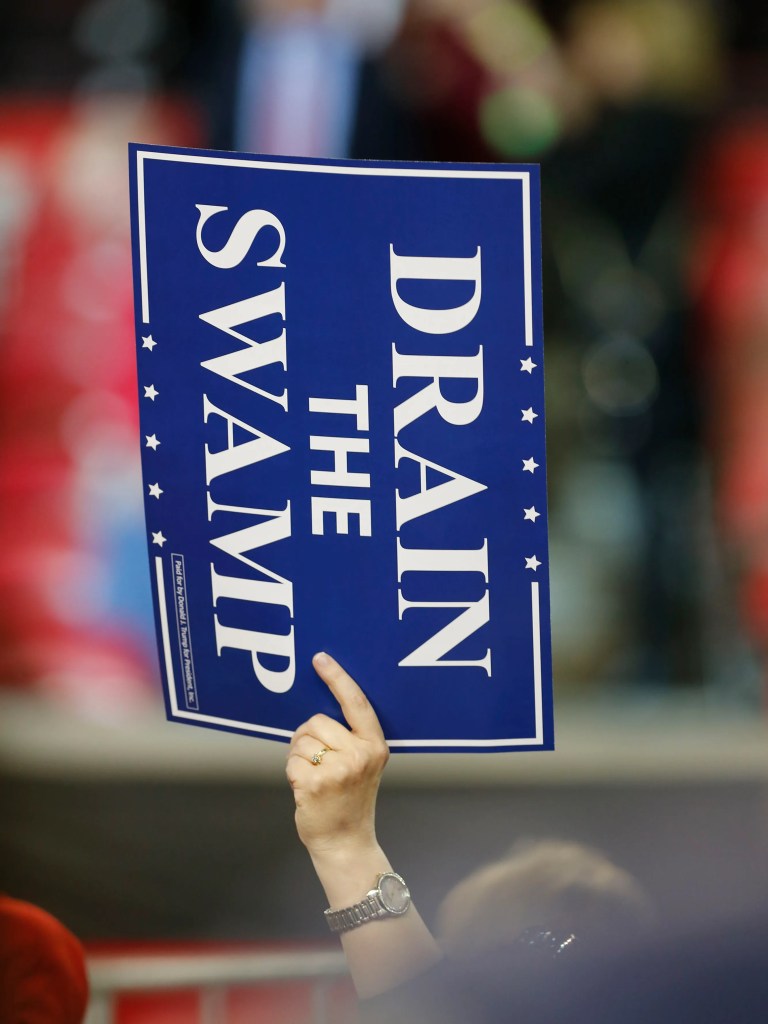
Once referring to special interest groups and lobbyists, ‘draining the swamp’ has come to include career politicians and their staffers who have planted themselves and influenced D.C for decades.
When long standing American political institutions tried to make sense of Donald Trump’s election in 2016, it became clear that his lack of experience in office was one of his most appealing characteristics to voters. Rather than the deterrence that it was initially predicted to be. This was not the first time voters have turned to an outsider when there is a wide sentiment that their government is not working for them. And further it has happened again since. However, rather than repairing the relationship between citizens and their government, when outsiders are elected more damage to that relationship becomes the likely result and we are likely to see it play out in Trump’s second term. And this reality is likely to make the average American feel trapped, where the established and experienced institutions do not care about citizens and the outsiders who step up are too incompetent to be the solution.
As Trump unveiled his cabinet for his second term it became clear that while there were some conventional picks such as Marco Rubio for Secretary of State, Trump was keen to load up the executive branch with outsiders just like himself. And why shouldn’t he? It’s what his supporters voted for, and they are more likely to be open to working to his unconventional style of governance.
A team of outsiders who will shake up Washington D.C and are not bound by the institutions of the Capital that voters feel have abandoned them, is exactly what voters have voted for. The American people have grown distrustful of D.C. They feel unheard and believe the lawmakers only look after their donors. And the solution that voters have opted for is to ‘drain the swamp’. To fill decision making positions with new blood and minds that have not been moulded decades of working within the Washington D.C. system. Not only has Trump’s cabinet fulfilled these wishes, he has appointed outsiders who have echoed the constituency’s feelings of government distrust.
Decreasing the size of the government is an appealing proposition to a population who have grown tired of their elected officials and the institutions that those officials work under. Decreasing the reach of the government will naturally be actioned by a team of people who are sceptical of the government’s role in people’s lives themselves. The people who make up this team are naturally going to be people from outside of previous public service. A smaller government demands those with anti-government views to step into law-making positions.
So, Trump is giving voters exactly what they have asked for. The problem? Filling the U.S cabinet or any legislative institution with government sceptics and outsiders will not create a government that voters better identify with. Nor will it restore faith in government to deliver better outcomes. In fact, the opposite is true.
The executive arm of the government is being filled with individuals who do not understand how the nation’s capital operates or how to effectively execute policy and vision within the field of public service. It is inevitable that this will lead to chaos, in-fighting and a lot of noise without much action. From a voter experience this is going to look like just another case of government dysfunction which drove voters to put these anti-government thinkers into positions of power in the first place.
Tulsi Gabbard, RFK and Mehmet Oz are all cabinet appointees who have previously expressed undermining views towards the departments that they have been appointed to lead. It is not unreasonable to assume that they will enter their positions bringing some level of hostility to the existing management that they will be inheriting from previous administrations. It is also not unreasonable to assume that the decision makers who are staying in their positions over the transition period will too bring some hostility and potential resentment.
U.S cabinet members who questions the expertise and authority of their own departments is only going to lead to further distrust and further undermine the buy in that people have in Washington D.C’s institutions.
The consequences could also be far greater than a dysfunctional four years. While government trust can be quickly exhausted, it is much slower to rebuild. Furthermore, more experience of an ineffective government is likely to only make outsiders and critics of government as an institution even more electable feeding a cycle that leaves the American people dissatisfied. Additionally, the people and organisations that make up “the swamp” have clearly already left the American people dissatisfied.
While perhaps not as satisfying as the quick fix of draining the swamp entirely, the real solution is much slower. Rather than trying protect the traditions of how government is run or to try and dismantle the institutions entirely, a government that the average American can trust to work in their best interest will occur by making public positions of influence more accessible to the average citizen who has enthusiasm for what the government could be. And that starts by removing the barriers to entry, and challenging to policies that protect the major two parties from third parties and independents.
Ultimately, the idea of draining the swamp and aboloshing the reach of the government may sound like an appealing way to create a clean slate. It may also seem although, that the best people to do the job are the people who also criticise the role of the government. However, these people do not know how to govern and are rarely effective at acheiving anything in a system that they have no experience in, and do not understand the nuances of. The hostile approach that they bring only further damages the relationship between the people and their government. Over the next 4 years Trump’s team of outsiders are likely to undermine what little trust Americans still have. This all part of a cycle that the U.S has found itself in, where disenfranchised voters vote for inexperience. This creates chaos which draws more voters to vote for more inexperience.
 The Last Week's Journal
Leave a comment